Categories
Uncategorized

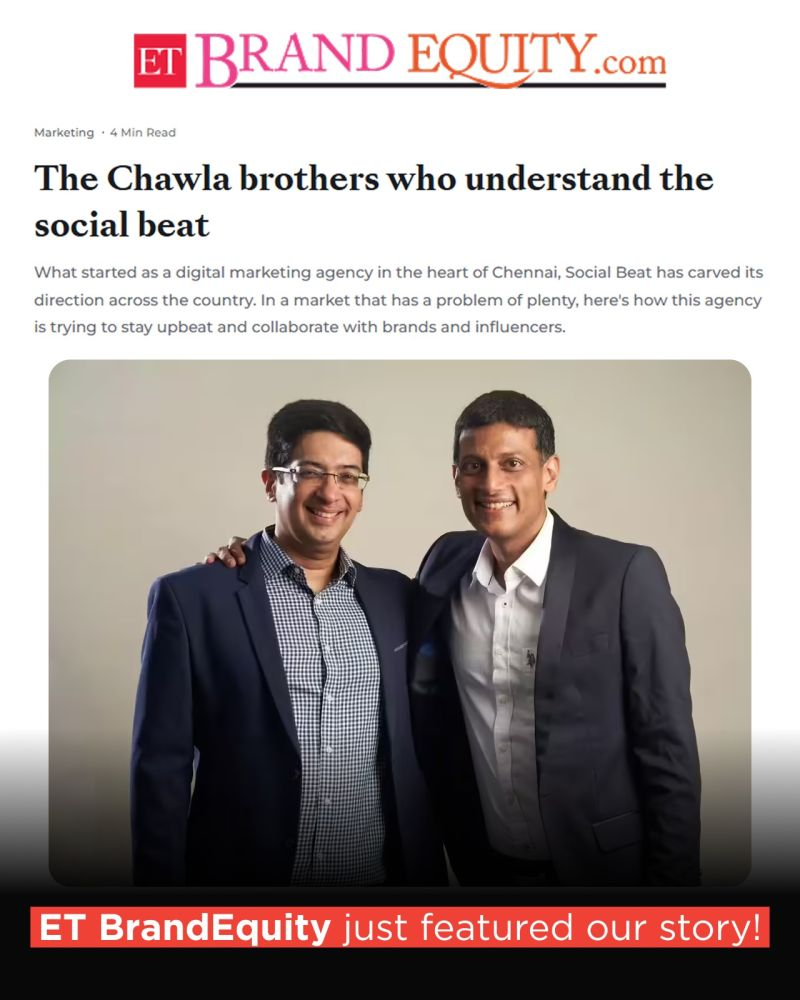
ET Brand Equity showcases the journey of Social Beat

We decided not to get out of our comfort zone and built our agency from our hometown. Thanks to ET BrandEquity for featuring this story in their recent article!

In 2012, Suneil & I set up Social Beat in Chennai. At the time, most digital agencies were starting in Mumbai or Delhi.

Our approach was simple: start where you understand the ecosystem best, then expand strategically.

Early on, we learned that brands wanted partners who could execute effectively and drive measurable results.

That’s why:

📍We invested in senior talent.
We have 15 senior leaders for a 300-member team, which sounds crazy expensive. But our client retention rates are higher than most agencies of our size.

📍We embraced technology and AI early.
Our internal AI tool, called Creative Catalyst, increased productivity by 15%, helping us deliver campaigns faster and reduce costs for clients.

Now we’re working on:

→ Evolving our influencer vertical – a platform for brands to discover creators and track analytics. We are already up to 500k curated creators on the platform

→ Building Prism – our programmatic platform that helps businesses bring in media efficiency, measurement, tracking business outcomes & creative analysis all in one place

What I appreciate most is how ET understood our philosophy. We don’t just want to be a tactical execution partner. We want bottom-line impact for our clients.

Eleven years of proving that location doesn’t define capability.
That senior talent investment pays off.
That technology should reduce costs, not increase them.

Thanks to our team, clients & partners who made this happen. Thanks to Priyanka Nair and the ET BrandEquity team for taking the time to write about our story.

P.S. Which business philosophy have you stuck with despite people saying it’s wrong?

You can read the full feature here: https://brandequity.economictimes.indiatimes.com/news/marketing/the-chawla-brothers-who-understand-the-social-beat/124069321

Categories
Uncategorized

Our Lacto Calamine Influencer campaign crossed 10+ million organic views

10 million organic views in 5 days – only possible with an influencer campaign!

I am talking about Lacto Calamine and how they reimagined creator collaborations, one micro series at a time.

Partnering with Social Beat and Influencer.in, the brand moved from one-off collabs to micro web series. It was short, snackable, creator-led storylines that blur the lines between entertainment and brand storytelling.

Each series was scripted, emotional, and refreshingly real. They explored insecurities, relationships, self-confidence, and identity, all while the sunscreen sat naturally at the heart of it.

The result?
→ Over 10 million organic views in just 5 days
→ 60,000+ shares, 50,000 saves, and an engagement rate of 57%

And this is just the beginning. More creators are joining the journey soon.

This wasn’t plug-and-play influencer content. It was co-created storytelling with creators handpicked for their authentic voices and given the freedom to speak the language of Gen Z.

We didn’t want to talk to Gen Z. We wanted to speak their language and that made all the difference.

A big shoutout to the Social Beat team and the incredible folks at Piramal Consumer HealthcareAashna Bhatia, Sawan Acharya, Aditya Sharma and Shruti Punn for making this possible.

And to our brilliant creators for proving that authentic, creator-first storytelling can be both impactful and organic.

Check this link to watch one of the episodes. Fair warning though, it doesn’t look like an ad at all: https://www.instagram.com/reel/DPOcTKOjMIz/

Categories
Uncategorized

YouTube Brandcast 2025 showcased our creator work with Sebamed India

2 weeks ago, our work with sebamed was showcased at YouTube Brandcast, and we couldn’t be prouder to partner with them!

Sebamed is a personal care brand. They recently launched a Gentle Facial Cleanser and needed to build awareness among premium consumers who care about skin health.

The campaign delivered exactly what we promised:

→ 20x increase in brand searches
→ 50M premium consumers reached with precision
→ Creators as authentic commerce drivers
→ 2X Growth in Sales

What I love about this recognition is that it validates something we’ve believed for years –

📌when you give creators the right brief and the right support, they become powerful brand advocates.

📌choosing the right platform is crucial. We focused entirely on YouTube.

For Sebamed, this wasn’t just about awareness. It was about building genuine connections with audiences who care about skin health.

The Brandcast feature is a great validation, but the real win is seeing how creator-led strategies are becoming mainstream for premium brands.

Thanks to YouTube and the Sebamed team, who trusted our approach.

Sometimes the best campaigns happen when clients are willing to think differently.

What’s your take on creator-led commerce?

P.S. Read this post for more details about the strategies we use-
https://lnkd.in/eVMaTczHActivate to view larger image,

No alternative text description for this image
Categories
Uncategorized

7 Google AI marketing updates you must know in 2025

1/ AI Mode & AI Search
Google Search is now multimodal and exploratory. With tools like AI Overviews, Lens, and Circle to Search, the search experience is no longer just typed keywords.

AI Overviews alone have increased commercial query volume by 10% in core markets. Brands now show up not just for what people type, but what they ask, scan, and see.

2/ AI for Shopping
Google has added AI to create try-on visuals, lifestyle images, and video ads.

They’re even auto-suggesting campaigns and promotions based on product trends. Users can shop for what they see on Google without clicking away.

3/ Smart Bidding Exploration
It actively targets unobvious but high-value searches like “how to buy a home.” Campaigns using it saw an 18% increase in unique search categories and 19% more conversions.

4/ Google AI for Creativity
Google launched Asset Studio and upgraded Product Studio.
→ Turn an image into a video with Veo.
→ Expand scenes with AI outpainting.
→ ‘Generated for you’ feature analyzes trends to suggest campaign concepts, featured products, and discounts.

5/ AI for Search Campaigns (AI Max)
AI Max campaigns adapt your text, CTAs, and even target URLs based on real search behavior. L’Oréal saw a 2X conversion rate and 31% lower CAC using it.

New controls like “locations of interest” and brand safety filters offer precision even with broad automation.

6/ Marketing Advisor
Google Ads is now building agentic co-pilots. Basically, AI experts who live inside Chrome.

They offer keyword ideas, detect broken tags, and can troubleshoot campaigns on the fly.

7/ Google Commerce Media Suite
If you’re in retail or DTC, this is the big one. Google is merging off-site ads (like Search Ads 360, DV360, and YouTube) with direct performance metrics from retailers like Shopee, Flipkart, etc.

You’ll be able to track product-level effectiveness and even integrate sales data into campaign goals.

Which one of these AI updates are you most excited to try first?

Source: Linkedin Post

Categories
search engine social beat social media web design

Follow our Blog on Social Beat

Hey everyone,

I am now writing on the blog of our company, Social Beat and will not be posting on my personal blog in the near future. Please follow our blog at https://www.socialbeat.in/blog where I and +Suneil Chawla write about social media marketing, search engine marketing, website design and ecommerce.

Feel free to write in with your feedback to me at team@socialbeat.in

Regards,
Vikas Chawla

Categories
digital divide digital marketing internet

Are we noticing the Digital Divide around us?

There are multiple incidents that let to me writing this post, but want to highlight two of them.

I recently visited Manipur (Imphal) and to my dismay, I was unable to use my data card over there due to lack of connectivity. Another incident happened a few months ago when I was at our company guesthouse in Mumbai. I was trying to get the wi-fi to work on my laptop and since it was giving issues I asked the caretaker, Deepak if the wi-fi was switched on. Deepak, a young and enterprising guy quickly took out his mobile phone and browsed the web to confirm that wi-fi was indeed switched on.

These two incidents point out to the digital divide in this country. While our population is 121 crores as per the 2011 census, most industry estimates put active internet users in 2012 at less than 10-11 crores i.e. around 8.5% of the population. Even global estimates show a penetration of 8.5%. The number of active mobile internet users has touched about 4-4.5 crore users as per the ICube report by IMRB. This is in-spite of the fact that 2011 was a pivotal year for the mobile and internet industry, highlighted by the rise in usage of smart phones and other devices. Moreover, this is in comparison to China was has an estimated 50 crore base of active internet users.

Another interesting point to note is that resumes and matrimonial ads are growing at phenomenal rates. Recently, IAMAI released data which shows that in the month of April 2012 alone 2 million resumes and 2.75 million matrimonial ads were uploaded and 5.56 million e-tickets were issued.

So at one end, where you have usage of internet in smart phones and more meaningful usage, on the other hand the overall penetration is barely 10% of the population so practically 90% of the population does not come in touch with any form of internet. But is giving access the solution?

In its recent article New York Times highlights that with expanded digital access, wasting time is the new divide. Just by increasing access of devices is not going to make life better for everyone. It took researchers at Digital Divide Institute whole decade to figure out the real issue is not so much about access to digital technology but about the benefits derived from access. The benefits could range from education, healthcare, commerce etc. So the question is whether the internet helping farmers sell better to modern retail or is it helping the farmer’s kids play a violent video game?

Some insights can be seen here but what are your thoughts and experiences? Is the situation getting any better?

Categories
cycling India

The Circle of Life & Cycling

On an average there are about 25 cycling related events that take place in India every single day of the year. Cycling in India has indeed come a long way from a vehicle of commute from the 70s to where it is today. There was a time when cycles were used by the police, used as a gift for the wedding, used for commuting to work and were a sign of prestige. The traditional Indian bicycle has gone through a circle wherein even just a decade back, it was seen as a poor man’s vehicle in India. Bicycles are coming back in to fashion and now there are so many domestic and international bicycles available in the market. This is because cycling is one of the most eco-friendly means of transport whilst at the same time keeping you fit. This combined with the rising fuel prices has helped cycling grow prominence in urban India. In an era of tablets, apps and mobiles, it is also the perfect vehicle to keep the kids outdoors and fit.
 
While there may be well over 50 cycling clubs in urban centres across the country (some of whom have a few thousand members), the bicycle penetration could be a lot better in urban and rural India. Economic Times reported that India has one of the lowest bicycle use in the world — about 1% of all commuting. So inspite of the few thousand cycling events that take place in India every year, the country has a long way to go.
 
There are a few things that are helping to build the momentum. Firstly, bike rental and bike sharing programs are beginning to be piloted. Many global cities like Paris, London, and Amsterdam, provide user friendly facilities for parking and renting bicycles and we are starting to see that in cities like Mumbai and Bangalore. Three students from the social entrepreneurship batch of the b-school NMIMS, started a cycle sharing program in Mumbai two years ago called Cycle Chalao. The idea was apparently born out of the everyday frustration of dealing with autorickshaw drivers. Now, they have been invited to build and operate India’s first city-wide bike-sharing system in Pune. They are also working with India’s Ministry of Urban Development for a bike-sharing pilot across 10 cities. A similiar venture has also been started in Bangalore.
 
Secondly, some states have even started initiatives of bicycles lanes and bicycle racks in local buses. For instance, Bangalore Metropolitan Transport Corporation, which runs the city’s fleet of commuter buses, has now come up with a bicycle rack in the buses for cyclists to mount their bicycles on. This would shortly be implemented in inter city and interstate buses. Such infrastructure is slowly encouraging more and more young professional to cycle to work. One can find communities in Bangalore, Pune, Mumbai and Chennai of professionals who ride their cycle to work. They use protective gear, safety accessories (reflectors, lights). Some even carry a whistle to attract people’s attention when there is traffic. They do manage to get to work in less time and also complete their fitness workout enroute to work. Some restaurants have also started having cycle stands to promote cycling.
 
Then there are others who are taking up cycling as a sport. Such as F1 racer, Karun Chandhok who cycles 60km to 120km a day depending on the day and route. While he is not a professional cyclist, cycling is an integral part of his fitness regime. Mountain biking has also become a sought after adventure sport, again driven by young professionals. Competitions like the nine-day endurance race called MTB Himachal further help this cause. Each year there are over 120 professional and semi professional cyclists who take up this 540km endurance race.
But it’s not just a urban india phenomena. Cycle is also becoming a wheel of social change with various Indian states having welfare schemes to give out bicycles. This helps children, especially rural girls to become more independent. It is making it easier for students to travel to school to the nearest village. It is empowering the youth and allowing them to be part of the circle of change and development that India is going through.
So, if you haven’t got a cycle or haven’t ridden one in a long time then you should get one or rent one and experience the thrill all over again. I myself bought one 2 months ago. I have clocked only 20km till date but its a start – Now, its your turn
Categories
career dreams life passion Pausch

Don’t feel guilty if you don’t know what you want to do with your life

I write this post as I have just been transferred into a new role within one of the group companies – a role which I don’t know much about. I will be marketing premium / performance bicycles in India – neither do I know cycling and neither do I know anything about marketing. As I take up this new assignment I took some time off to think about where am I heading with my career.

One of my favourite songs is “Everybody’s Free” by Baz Luhrmann – it’s a song that always makes me reflect. One of the lines in the song goes like this – “Don’t feel guilty if you don’t know what you want to do with your life…the most interesting people I know didn’t know at 22 what they wanted to do with their lives, some of the most interesting 40 year olds I know still don’t”. I take inspiration from this song as I write this post – and also a big cheeers to everyone out there who still don’t know what they want to do with their life. Remember, you are not alone.

Wendell Berry in his article on “work-life balance asks “why should one think of life as distinct from work”. He questions the concept of “work life balance” – according to him one would need work life balance only when you are not living your calling and only if you are not enjoying what you are doing. Many people say that you need to find your passion and then convert that into your career – but the larger question lies in how do you find out what you are passionate about. It’s not always easy to figure that out. I often reflect what makes me tick – and I still find it very hard to answer the question. Moreover, can your job always be your passion? or should you pursue your passion in your free time?.I have varied experiences in life – be it an executive assistant role at murugappa, a general management role at aiesec, a hr role at Taj or a marketing role at tata interactive. So what am I passionate about? About hr? about leading people? About transformation and change? About marketing? About anything entrepreneurial? Maybe all of the above? Or maybe none of the above? Or is it something that changes over a period of time.
One thing I have come to understand is that if you want to understand your passion – you need to see what you are “good at” or what you are “happy about”. Rahul Bose made a lot of sense in his recent talk where he spoke about how you should look for that “one day at work that makes your happy the most” and try to do more of it – if need be, by shifting jobs. At the same times its critical to listen to other people’s advice to understand what you are good at or to understand what makes you happy. The understanding comes from personal reflection as much as from external advice. It can take time – and one should give it time.
As I look back at all external advice and person reflection to connect the dots (as Steve Jobs mentions in his Stanford speech), I can make some sense of my life. I don’t think I know exactly where I am headed but I know the direction. I have understood that I am good at building relationships and I am process oriented and that I have dreamt of being an entrepreneur since my adolescence. Though its not a clear dream, nor a clear goal, I know I am going to turn entrepreneur in the near future because I recognize that my dream should have a priority in my life. With my dream is in the background – my varied experiences are going to play a critical role in shaping the person I want to be. Especially my marketing role because I will have to connect with the consumer to ensure profitability of my segment – this skill is going to be critical to me as an entrepreneur.

As I complete this post, I urge you to watch this video on “Achieving Your Childhood dreams” by Late. Prof. Randy Pausch. This is most inspiring video I have ever seen.

A wise man once said “For a dream to become a reality you have to treat it like it’s real”. I would love to hear from you on whether you are following your dream and how far you are in making your dream real.

Categories
entrepreneurship honey bee network innovation rural entrepreneurship

India’s most powerful rural entrepreneurs

Forbes recently profiled 7 rural entrepreneurs whose “inventions are changing lives” of the people across the country. The entrepreneurs were selected by the Honey Bee Network, founded by Prof. Anil Gupta. The network identifies and documents innovators and have been the source of pollination and cross-pollination of ideas, creativity and grassroots innovations.

Categories
entrepreneurship frugal engineering India innovation jugaad Muruganantham tedx

Redefining Entrepreneurship – the jugaad way

Call it ingenuity, call it frugal engineering, call it toilet paper entrepreneur or call it Jugaad – entrepreneurship is being redefined in India. A lot of this is actually happening away from the urban areas. While innovations of large companies like Tata and Godrej’s Chotu Kool have been extensively covered by media, the less known entrepreneurs are equally interesting.

I met one such entrepreneur 10 days ago at TEDx Chennai. It so happened that he was not one of the speakers. The TEDx team had identified a few entrepreneurs who were showcasing their venture and products during the umpteen breaks. It was at one of these stalls that I saw this assuming guy sitting with his laptop. Not too many people were approaching him because he did not have an fancy product on the table – but he had an inspiring story to share. I, along with my brother and a friend were humbled by his modesty and his approach to life.

His name is Muruganantham. He is a school dropout, but has installed an innovative small-scale model to manufacture sanitary napkins that enables rural women to lead a hygienic lifestyle and has encouraged rural women to turn entrepreneurs. Till date he has installed 250 such machines installed across 18 states.  This has lead to creation of 250 women entrepreneurs and has generated employment of around 2000 people.

Muruganantham’s machine converts the elaborate process of manufacturing sanitary napkins into a Gandhian operation. The tools used in this model are as much “machines” as the charkha, the pestle or the grindstone. It operates on simple tasks that can be mastered within 1 day, and he himself trains these women entrepreneurs. Through his innovation he has been able to addresses the issue of sanitary napkins being unaffordable and/or unavailable to around 97% of Indian women.

It took him 4 years of research to create this jugaad machine at a cost of Rs.75,000 (while large machines of similar kind cost Rs.35 million), but  he did not think of creating a “for-profit” enterprise – “money is a by product” as he told us. He shared his experience of speaking at TiECon in Mumbai where he asked the elite audience – “When a school dropout from a small place in Coimbatore can think of making his innovation useful to society, why don’t you educated people think on these lines?“. Muruganantham is truly an inspiring individual.

There are many others like Muruganantham who have created innovative products or services such as:

There will be many such more examples and I would love to hear from you if you have come across any.

A lot of these innovations are also curbing the rural to urban migration which has been rapidly rising. By creating entrepreneurs, by training and by generating employment these entrepreneurs are creating a more inclusive India. Of course jugaad alone cannot be enough as some have pointed out, but this is the start of a positive change in redefining entrepreneurship in India.